Showing posts with label Ecuador. Show all posts

Friday, May 7, 2010

Blogopagos - The Dread Pirate Frigates (or So Long and Thanks For All The Fishes)


I once again find myself writing an entry from an airplane, this time between Galapagos and Guayaquil, where I'll catch my final flight home to New York.  Before moving on, though, I thought I'd write a bit about my last three days aboard the Angelique.  In particular, I want to discuss our trip to Genovesa, the island that, among those I had not yet seen with the Cachalote, I most wanted to visit.

Genovesa is most noteworthy for its enormous population of nesting Great Frigatebirds.  I've mentioned the frigatebird a bit already, and I knew that I found them fascinating, but getting to observe them up close crystalized my feelings.  Let's get this out there now: frigatebirds are assholes.  They are the assholes of the bird world.  Seriously, total jerks. Frigatebirds*, also known as Man-O-War birds**, are most well known for their piratical habits.  They steal everything they get.  I've already mentioned that they often get food by harrassing other birds into disgorging a fresh catch, and swooping down to snatch it before it hits the water.  It turns out they do this with nesting material as well, as I've now seen firsthand.

On Genovesa, we witnessed scores of Red-footed Boobies--the tree-dwelling and alternate-colored cousin of the Blue-footed and Nazca varieties--cutting small twigs from bushes with their beaks, and attempting to fly them back to their loved ones.  You'd think birds would leave them alone.  After all, they're just trying to build a good home for their kids.  Well, most of the time, not a moment after the booby took flight, a frigatebird would swoop in from above and start pecking at and colliding with the booby.  Occasionally, the booby would escape with the twig still in its mouth, and make it home--or at least out of my line of sight.  For the most part, however, the incredibly dickish behavior of the frigatebird would cause the booby to freak out and drop its twig.  As impressive as it may have been to then watch the frigatebird swoop down faster than the twig***, great feats of athleticism don't make up for shoddy morals.  This ain't the NFL.

As I watched these acrobatic thugs do what comes naturally, I struggled to find the appropriate analogy.  I initially thought it a bit like a neighborhood with a heavy mob presence.  The frigatebirds take a taste of all the food and all the construction materials.  The problem with that analogy is it would have to be a combined mob neighborhood / police state, because if you really lived in such a neighborhood, you would always have the option to leave it, and you almost certainly would.

I think, at the end, it's most like a normal American high school.  I say "normal" because this kind of thing didn't really go on at the artsfest I attended during my formative years, but that's beside the point.  The frigatebirds are the bullies and the red-footed boobies are the A/V club.  Or the sci-fi club.  Or the D&D club.  Or Mathletes, perhaps.  Take your pick.  The only difference is that, in PS Genovesa, there are about twice as many bullies as there are nerds.  The nerds wish more than anything that they could escape to a place without bullies, but they have nowhere else to go really.  This is where the fish are, so that's where the nerds stay.  So, the nerds have no real choice but to tolerate the frigatebirds' stealing their lunch money and their twigs.  The boobies occasionally yell a bit in exasperation, and even throw the odd weak-looking peck.  But they never really manage to retaliate in any meaningful way.

The courtship traditions of the frigatebird are also noteworthy.  The male frigatebird has a big red throat-pouch that he can inflate to impress the females.  If I may continue the game of "Torture That Analogy," (a favorite pastime of my brother Art and I), it is the bird equivalent of  the bully--clearly already overcompensating for something--stuffing a sock in his pants.  Often, on Genovesa, one will come across a large group of male frigatebirds sitting on the ground with their pouches fully inflated, waiting for a female (who has a very visible white patch of feathers in lieu of the pouch) to fly overhead.  Whenever this happens, the males spread their wings and shake them, proudly displaying the size and redness of the pouch.  In order to ensure the female's attention--just in case she might confuse the group for little Jimmy's fourth birthday celebration--they ullulate.  Eventually, the female will choose the "ballon rouge" that suits her fancy the most, and settle down with a male.  She will then blissfully pretend, a la Carmela Soprano, that the twigs and aluminum siding he brings her have come from an honest day's work****.

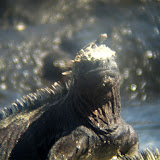
At any rate, Genovesa, isolated in the northeastern part of the archipelago and located fully north of the Equator, is unique because it is the only island that has neither introduced species nor land reptiles (of Galapagos's two iguana species, only the marine variety has made it as far as Genovesa).  As a result, it is so full of birds as to be an appropriate setting for a remake of the Hitchcock movie.  In addition to the frigatebirds and all three kinds of boobies (though Blue-footed are not very common there, and nest on other islands), it has a wealth of Red-billed Tropicbirds and a freakish amount of petrels.

The petrels pass their time trying to impress each other with aerial acrobatics along the cliffside, sweeping and swooping all over the place.  The boobies and frigatebirds, by contrast, mostly just sit there and try to mate, giving off a range of freakish noises.  As on the other islands, one can walk right up to the larger nesting birds.  In addition to large amounts of puffed-up frigatebirds, we got to witness a Nazca Booby***** couple preparing to mate.  The nesting ritual of the Nazca Booby is so endearing it makes me want to adopt a pair of them.  First, as do all species of booby, they do a little dance with each other.  Next, however, the male starts to help the female build a nest.  Rather than fly off and find some good material for a foundation, like the other birds in the area, he just looks in his immediate vicinity.  Upon finding a twig or a small pebble, the male will pick it up in his beek, and very gently place it at the foot of his mate.  He will proudly repeat this process at least a few times, each time newly giving his bride the precious gift of a thing he just found.

As with any small cruise in Galapagos, we spent our fair share of time in the water as well.  This time, however, the sights on land outshone the experience underwater, though there were certainly some good things to see below the surface.  The water was very murky in Genovesa--less so in Bartolomé, which I had visited with the Cachalote and to which I returned with the Angelique.  However, I did manage to see three major animals I had not previously seen, as well as a few new fish.  In Playa Las Bachas, on the northern part of Santa Cruz, I saw a juvenile Galapagos Shark.  Fully grown, these are slightly bigger than the white-tipped sharks, and more menacing-looking as well.  In the obscure waters of Las Bachas, it appeared as a silvery flash in front of me, and then swam past without paying much attention.  At Genovesa, we briefly saw an iguana in the water, feeding on some seaweed.  I had seen this from land, but this was my first time in the water with one.  Unfortunately, right as I got out my camera to take a picture, an enormous wave knocked us back about fifteen feet, and I missed my chance.

A short while later, we came across a fur seal, which is a relative of the sea lion, of course, but which behaves differently.  Fur seals are nocturnal, so when they get into the water during the day, it's usually just to relax a bit.  Their standard approach, which we witnessed, is to lie upside-down at the surface, all four flippers facing the sun, and head facing down.  It's not as curious or playful as its Californian cousin, but it's still a lot of fun to watch.

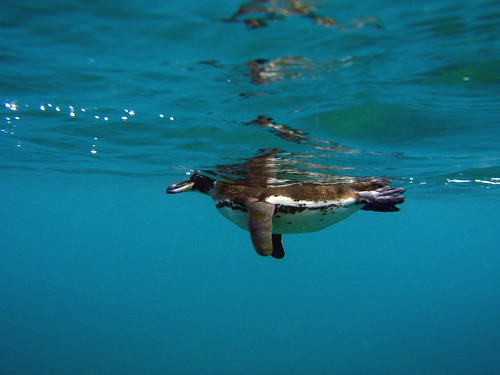
Yesterday, in Bartolomé, I hoped to get another opportunity to swim with a penguin, and capture the photo that I missed last time.  Although we saw a few of them sunning themselves as we swam by, our group apparently missed the only one that had been swimming by about five minutes, so it seems it was not in the cards.  Fortunately, there's an important lesson to be taken from this.  The thousands of pictures I've taken in the last four months serve as a wonderful record of all the excitement of this trip.  They are, however, just that--a record.  They are not, themselves, the point of the trip.  As much as I might feel like kicking myself for not checking my camera before the first time I got in the water at Bartolomé, I am so lucky to have had the unique experience of swimming with a penguin in the first place, to say nothing of everything else I've had the opportunity to do in the last four months.  The lesson is an obvious one, of course, but it was nonetheless good to be reminded of it before heading out with only the memories in my head and the pictures on my computer.

So, all told, I had an excellent final few days in Galapagos.  Of the nine islands I visited in the archipelago, it would be very difficult to pick a favorite.  Genovesa, however, would be in the top three, along with Española and Fernandina.  Anyway, I started writing this post this morning on the flight from the islands to the mainland, and I'm now finishing it in the air over South America, only five and a half hours from JFK.  This is not yet my last post, but that will happen soon enough.  I'll stop getting to self-importantly broadcast my opinions and I'll rejoin my friends and family in the rest of the world.  Not yet, but soon.

Saludos,
Seth

*The name, as I learned from Sid Meier in my youth, comes from the best boat a civilization can have before it discovers steelwork.

**Ibid, but switch in "colony" for "civilization" and "wins independence" for "discovers steelwork."

***Something high school physics class taught us would be impossible without air resistance.

****This part just works better with the mob analogy than the high school one.  Apologies for any confusion.

*****I suppose I should address, at long last, the fact that this species is called the "booby."  I'll just say two things about that: 1) The name comes from "bobo," which is a Spanish term for "clown," so given because of their mating dance, in which they show off their oversized feet.  2) Heh.

Fotografía:
Galapagos - Santa Cruz - Playa Las Bachas

Galapagos - Genovesa - Prince Phillip's Steps

Galapagos - Genovesa - Darwin Bay

Galapagos - Santiago - Sullivan Bay

Galapagos - Bartolomé - Pinnacle Rock

Galapagos - Santa Cruz - Charles Darwin Station

Thursday, April 29, 2010

Blogopagos - Come Sail Away

Green Sea Turtle and Me

I'm back on land after a week on a sailboat.  The eruption in Iceland of the Eyjafjallajökull volcano (pronunciation here) meant that a number of Europeans had to cancel their trips, meaning there were only six of us on the sixteen-passenger Cachalote.  It turned out that was just the start of a run of good luck.

Before I arrived in Galapagos last week, I was actually a bit concerned.  This is my last stop before returning home to New York.  How could I possibly put a proper cap on the trip of a lifetime?  Moreover, this place has always fully captured my imagination.  It seemed impossible for Galapagos to meet my unreasonably high expectations, especially coming on the heels of all the remarkable things I've seen in the last three and a half months.

Well, I was clearly underestimating the wonders of the Galapagos archipelago.  I thought I had things figured out when I wrote last week about the pelicans, sea lions, and iguanas I've been seeing.  Then I got in the water, and I experienced an entirely different world.  It seemed like every time in the water, the islands threw something new my way, and each experience even more mind-boggling than the last.

Swimming with sea lions was cool.  They're extremely curious and playful, and will often swim right up to you and go around in circles, trying to figure out what you are before swimming off.  I was amazed and even gleeful.

Then I swam with sea turtles.  They're not as playful as the sea lions, but they're certainly beautiful and mesmerizing.  They're also very easy to follow for a while, because they don't generally move much faster than people.  They can when they want to, but don't generally seem to feel the need.

Then I swam with a shark.  Not a big one.  It was a white-tipped reef shark, which is about as long head-to-tail as I am head-to-toe.  Lest you fear for me, it's also worth noting that they're completely indifferent to people.

So, I was astounded by all I had experienced.  Using the underwater case I got for my camera, I got great pictures.*  I was extremely pleased with all I had seen and experienced.

Then I swam with a penguin.

I had taken my head out to talk to some of my fellow Cachalote passengers, when I heard the unmistakable call of a Galapagos Penguin**--it sounds like a little lamb looking for its mother.  I shouted to my fellow passengers, "penguin!" and swam toward it.  And there it was, tiny head above water, occasionally dipping below the surface.  Just a few feet in front of me, and swimming toward--and then right past--me.  I can't express how incredible that brief moment was (it swam off at a speed I couldn't match within a minute or two).  Galapagos penguins are the northernmost penguins in the world--the only ones that ever travel north of the Equator.  This is one of the few places where you have the opportunity to swim around with a little snorkel and mask, and look up to see the world's most adorable flightless waterfowl paddling your way, taking its head out of the water and calling out for a compatriot of the same species.

I lined up my camera, and had the penguin perfectly centered in the frame.  What I, infuriatingly, didn't realize until a few minutes later is that my memory card was full.  For the first time on this trip, I had forgotten to make sure there was room on my camera before going off to do something of which I'd want pictures.  On the plus side, I found this picture that someone posted, which is almost exactly what I saw, though from the other side.  But I've been kicking myself for the last 48 hours.

It's worth noting that if I didn't already know that there were penguins here, I wouldn't have believed it.  When you're getting sunburns in 80 degree heat, you just don't expect to look out at the water and see a bird most commonly associated with Antarctica.  Of course, now that I know that there are Flamingos in the Andes (as well as here, by the way), I suppose I'm a bit less surprised by the spread of interesting birds.

Of course, the underwater inhabitants aren't the only fascinating thing about Galapagos.  After all, the birds are even more famous, and Darwin himself was most interested in the volcanic geology and fresh lava flows.  So it is that the most impressive fact of the Galapagos once one leaves the comforts of Puerto Ayora is how unspoiled it all is.  There is an extremely focused--and successful--effort to preserve the ecosystem and let it progress naturally.  So it is that one sees huge colonies of marine iguanas--swimming iguanas that exist nowhere else, solitary and enormous land iguanas, flightless cormorants--which have evolved into swimming birds with awkward and useless vestigial wings, enormous albatross, and thousands upon thousands of specacular blue-footed boobies--which live up to their name with nearly flourescent webbed feet.  These creatures don't really seem to care one way or the other about people, and so don't bother to flee when you approach, creating amazing opportunities for observation and picture-taking.  I've been in Galapagos for a week and a half now, and I'm still having a hard time believing this place is real.  When people ask how it is, I have a hard time saying anything other than "almost fictional."  It really just seems like someone's imagined version of a wildlife paradise.

Before I head off to figure out my plans for my last week on the islands, I want to take a moment to thank Juan Tapia, the spectacular guide who led our Cachalote group around several islands for the last week.  Juan has 21 years of knowledge crammed into his brain, and he shared a sizeable amount of it with us.  He knew exactly when and where to take us so that we almost completely missed the other tour groups.  If you look through my pictures, you will rarely see anyone other than Juan or one of the other five Cachalote passengers.  If you ever make your way down to Galapagos, hope that you're lucky enough to get a guide as excellent and professional as Juan.  And if you bring along a guitar, you might--as we did--be able to get him to play you "Besame Mucho."

At any rate, although I'm still recovering from the last week aboard the Cachalote--sleeping on a sailboat for a week means that sleeping on shore again feels like you're rocking back and forth--I should get going and figure out what I'm going to do for an encore.  It's going to be hard to top the last week--completely unique in my life to date--but I now have a great deal of confidence in the endless array of surprises that lay hidden in the various corners of these incredibly special islands.

Saludos,
Seth

*As of this writing I have a bit fewer than half of my pictures uploaded, and none of the videos.  Internet is very slow out here, so most of this will likely have to wait until I've returned home to the states.

**One thing that our group observed is that there's an easy way to guess the name of the species of animal you're looking at.  It's almost certainly the Galapagos _______, where the blank is filled in with the type of animal it is.  See also the Galapagos Hawk, Galapagos Shark, Galapagos Land Iguana, Galapagos Marine Iguana, Galapagos Tortoise, Galapagos Flightless Cormorant--with which I also swam, Galapagos Cotton (the plant), and so on.  These islands are so isolated that so many species of life here have evolved completely separately from their counterparts in the rest of the world.

Fotografía:


Galapagos - Española - Gardner Bay

Galapagos - Española - Punta Suárez

Galapagos - Floreana - Champion Rock

Galapagos - Floreana - Punta Cormorán

Galapagos - Floreana - Post Office Bay

Galapagos - Isabela - Punta Moreno

Galapagos - Isabela - Elizabeth Bay

Galapagos - Isabela - Urvina Bay

Galapagos - Fernandina - Punta Espinosa

Equator

Galapagos - Santiago - James Bay

Galapagos - Bartolomé

Galapagos - Santa Cruz - Black Turtle Cove

Thursday, April 22, 2010

Blogopagos - Living in a zoo

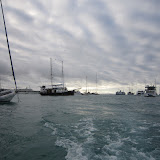
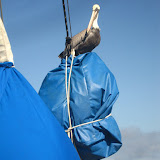
I'm at the bar at the Sol y Mar hotel in Puerto Ayora on the island of Santa Cruz, in the Galapagos.  The bar is in the back, and has a small pool and a deck which faces out into Pelican Bay--named for the many pelicans who live here and feed on the fish.  There's actually a pelican standing on the deck immediately adjacent to the pool, enjoying some shade, but no one's paying him much attention.  That's not actually surprising.  It's easy to miss a preening pelican when there's a sea lion swimming in the pool.


I've been here three days now, and easily the most striking thing is the total indifference of the animals to the humans around them.  The sea lions, in particular, are happy to put themselves anywhere that there's shade, whether that means on a bench or next to a table at the bar.  Some of the smaller finches and lava lizards might freak out and flee when approached, but one can walk right up to a sea lion, pelican, marine iguana, or giant tortoise without scaring it away.  Although there is now a decently-sized human population living out here--Puerto Ayora has over 10,000 inhabitants--it still has the feel of a place that evolved over the course of millennia free of human contact.  The Galapagos dove, which is basically a pigeon with a piercing blue circle around its eyes, was described by Darwin as being so oblivious that "I could kill by throwing my hat at it."

The animal that has actually captured my attention more than any other so far is the frigatebird.  It's rather large, with a wingspan similar to that of a vulture or some other large bird of prey.  Among the frigatebird's methods of obtaining food is a technique called kleptoparasitism.  In this, the frigatebird will identify another (smaller) bird--let's say a gull--who has just eaten, and harrass said gull until the it vomits.  Sometimes this involves catching the gull by the tail and shaking it aggressively in the air.  The frigatebird will then eat the regurgitated meal, taking the needed nutrients for itself.  Nature, as they say, doesn't fuck around.

The islands have a massive number of species of plants and animals that are endemic, meaning they don't exist anywhere else.  One of these is a form of prickly pear cactus that grows as a tree, and mostly appears along the coastline.  I'm still trying to figure out how to incorporate such a thing into my conception of reality.  I'm not there yet, but I'm getting close.

Another well-known group of endemic species is the finch family.  They're generally not that exciting to look at--they're quite small and the coloration isn't particularly thrilling.  But, given that they're the very birds that contributed so significantly to the development of Darwin's theory of natural selection, they end up being rather captivating.  What's funny, however, is that Darwin came here far more focused on the geology of the place--it's basically a big series of volcanos.  In fact, he barely even collected any samples of finches--just two of the thirteen or so species.  It was not until he got back to England that he realized what he had seen, and had to borrow samples from Robert FitzRoy, the captain of the HMS Beagle.  Accidental though Darwin's realizations may have been, it's fascinating and wonderful to be in the place responsible for them, and to witness firsthand the amazing biodiversity of an ecosystem left to evolve more or less on its own for thousands of years.

This evening I'll be boarding a schooner for a six-day cruise around the islands.  I'm expecting to see a lot of amazing things, and hoping to avoid letting the boat treat me like a frigatebird treats a gull.  I'll check back in when I'm back on land.

Saludos,
Seth

Fotografía:

Galapagos - Santa Cruz