Showing posts with label blogsherpa. Show all posts

Friday, May 7, 2010

Blogopagos - The Dread Pirate Frigates (or So Long and Thanks For All The Fishes)


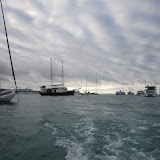
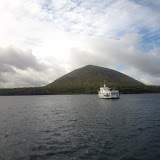
I once again find myself writing an entry from an airplane, this time between Galapagos and Guayaquil, where I'll catch my final flight home to New York.  Before moving on, though, I thought I'd write a bit about my last three days aboard the Angelique.  In particular, I want to discuss our trip to Genovesa, the island that, among those I had not yet seen with the Cachalote, I most wanted to visit.

Genovesa is most noteworthy for its enormous population of nesting Great Frigatebirds.  I've mentioned the frigatebird a bit already, and I knew that I found them fascinating, but getting to observe them up close crystalized my feelings.  Let's get this out there now: frigatebirds are assholes.  They are the assholes of the bird world.  Seriously, total jerks. Frigatebirds*, also known as Man-O-War birds**, are most well known for their piratical habits.  They steal everything they get.  I've already mentioned that they often get food by harrassing other birds into disgorging a fresh catch, and swooping down to snatch it before it hits the water.  It turns out they do this with nesting material as well, as I've now seen firsthand.

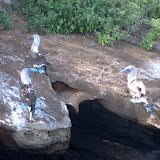
On Genovesa, we witnessed scores of Red-footed Boobies--the tree-dwelling and alternate-colored cousin of the Blue-footed and Nazca varieties--cutting small twigs from bushes with their beaks, and attempting to fly them back to their loved ones.  You'd think birds would leave them alone.  After all, they're just trying to build a good home for their kids.  Well, most of the time, not a moment after the booby took flight, a frigatebird would swoop in from above and start pecking at and colliding with the booby.  Occasionally, the booby would escape with the twig still in its mouth, and make it home--or at least out of my line of sight.  For the most part, however, the incredibly dickish behavior of the frigatebird would cause the booby to freak out and drop its twig.  As impressive as it may have been to then watch the frigatebird swoop down faster than the twig***, great feats of athleticism don't make up for shoddy morals.  This ain't the NFL.

As I watched these acrobatic thugs do what comes naturally, I struggled to find the appropriate analogy.  I initially thought it a bit like a neighborhood with a heavy mob presence.  The frigatebirds take a taste of all the food and all the construction materials.  The problem with that analogy is it would have to be a combined mob neighborhood / police state, because if you really lived in such a neighborhood, you would always have the option to leave it, and you almost certainly would.

I think, at the end, it's most like a normal American high school.  I say "normal" because this kind of thing didn't really go on at the artsfest I attended during my formative years, but that's beside the point.  The frigatebirds are the bullies and the red-footed boobies are the A/V club.  Or the sci-fi club.  Or the D&D club.  Or Mathletes, perhaps.  Take your pick.  The only difference is that, in PS Genovesa, there are about twice as many bullies as there are nerds.  The nerds wish more than anything that they could escape to a place without bullies, but they have nowhere else to go really.  This is where the fish are, so that's where the nerds stay.  So, the nerds have no real choice but to tolerate the frigatebirds' stealing their lunch money and their twigs.  The boobies occasionally yell a bit in exasperation, and even throw the odd weak-looking peck.  But they never really manage to retaliate in any meaningful way.

The courtship traditions of the frigatebird are also noteworthy.  The male frigatebird has a big red throat-pouch that he can inflate to impress the females.  If I may continue the game of "Torture That Analogy," (a favorite pastime of my brother Art and I), it is the bird equivalent of  the bully--clearly already overcompensating for something--stuffing a sock in his pants.  Often, on Genovesa, one will come across a large group of male frigatebirds sitting on the ground with their pouches fully inflated, waiting for a female (who has a very visible white patch of feathers in lieu of the pouch) to fly overhead.  Whenever this happens, the males spread their wings and shake them, proudly displaying the size and redness of the pouch.  In order to ensure the female's attention--just in case she might confuse the group for little Jimmy's fourth birthday celebration--they ullulate.  Eventually, the female will choose the "ballon rouge" that suits her fancy the most, and settle down with a male.  She will then blissfully pretend, a la Carmela Soprano, that the twigs and aluminum siding he brings her have come from an honest day's work****.

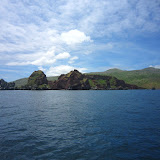
At any rate, Genovesa, isolated in the northeastern part of the archipelago and located fully north of the Equator, is unique because it is the only island that has neither introduced species nor land reptiles (of Galapagos's two iguana species, only the marine variety has made it as far as Genovesa).  As a result, it is so full of birds as to be an appropriate setting for a remake of the Hitchcock movie.  In addition to the frigatebirds and all three kinds of boobies (though Blue-footed are not very common there, and nest on other islands), it has a wealth of Red-billed Tropicbirds and a freakish amount of petrels.

The petrels pass their time trying to impress each other with aerial acrobatics along the cliffside, sweeping and swooping all over the place.  The boobies and frigatebirds, by contrast, mostly just sit there and try to mate, giving off a range of freakish noises.  As on the other islands, one can walk right up to the larger nesting birds.  In addition to large amounts of puffed-up frigatebirds, we got to witness a Nazca Booby***** couple preparing to mate.  The nesting ritual of the Nazca Booby is so endearing it makes me want to adopt a pair of them.  First, as do all species of booby, they do a little dance with each other.  Next, however, the male starts to help the female build a nest.  Rather than fly off and find some good material for a foundation, like the other birds in the area, he just looks in his immediate vicinity.  Upon finding a twig or a small pebble, the male will pick it up in his beek, and very gently place it at the foot of his mate.  He will proudly repeat this process at least a few times, each time newly giving his bride the precious gift of a thing he just found.

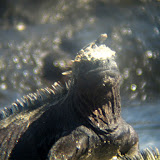
As with any small cruise in Galapagos, we spent our fair share of time in the water as well.  This time, however, the sights on land outshone the experience underwater, though there were certainly some good things to see below the surface.  The water was very murky in Genovesa--less so in Bartolomé, which I had visited with the Cachalote and to which I returned with the Angelique.  However, I did manage to see three major animals I had not previously seen, as well as a few new fish.  In Playa Las Bachas, on the northern part of Santa Cruz, I saw a juvenile Galapagos Shark.  Fully grown, these are slightly bigger than the white-tipped sharks, and more menacing-looking as well.  In the obscure waters of Las Bachas, it appeared as a silvery flash in front of me, and then swam past without paying much attention.  At Genovesa, we briefly saw an iguana in the water, feeding on some seaweed.  I had seen this from land, but this was my first time in the water with one.  Unfortunately, right as I got out my camera to take a picture, an enormous wave knocked us back about fifteen feet, and I missed my chance.

A short while later, we came across a fur seal, which is a relative of the sea lion, of course, but which behaves differently.  Fur seals are nocturnal, so when they get into the water during the day, it's usually just to relax a bit.  Their standard approach, which we witnessed, is to lie upside-down at the surface, all four flippers facing the sun, and head facing down.  It's not as curious or playful as its Californian cousin, but it's still a lot of fun to watch.

Yesterday, in Bartolomé, I hoped to get another opportunity to swim with a penguin, and capture the photo that I missed last time.  Although we saw a few of them sunning themselves as we swam by, our group apparently missed the only one that had been swimming by about five minutes, so it seems it was not in the cards.  Fortunately, there's an important lesson to be taken from this.  The thousands of pictures I've taken in the last four months serve as a wonderful record of all the excitement of this trip.  They are, however, just that--a record.  They are not, themselves, the point of the trip.  As much as I might feel like kicking myself for not checking my camera before the first time I got in the water at Bartolomé, I am so lucky to have had the unique experience of swimming with a penguin in the first place, to say nothing of everything else I've had the opportunity to do in the last four months.  The lesson is an obvious one, of course, but it was nonetheless good to be reminded of it before heading out with only the memories in my head and the pictures on my computer.

So, all told, I had an excellent final few days in Galapagos.  Of the nine islands I visited in the archipelago, it would be very difficult to pick a favorite.  Genovesa, however, would be in the top three, along with Española and Fernandina.  Anyway, I started writing this post this morning on the flight from the islands to the mainland, and I'm now finishing it in the air over South America, only five and a half hours from JFK.  This is not yet my last post, but that will happen soon enough.  I'll stop getting to self-importantly broadcast my opinions and I'll rejoin my friends and family in the rest of the world.  Not yet, but soon.

Saludos,
Seth

*The name, as I learned from Sid Meier in my youth, comes from the best boat a civilization can have before it discovers steelwork.

**Ibid, but switch in "colony" for "civilization" and "wins independence" for "discovers steelwork."

***Something high school physics class taught us would be impossible without air resistance.

****This part just works better with the mob analogy than the high school one.  Apologies for any confusion.

*****I suppose I should address, at long last, the fact that this species is called the "booby."  I'll just say two things about that: 1) The name comes from "bobo," which is a Spanish term for "clown," so given because of their mating dance, in which they show off their oversized feet.  2) Heh.

Fotografía:
Galapagos - Santa Cruz - Playa Las Bachas

Galapagos - Genovesa - Prince Phillip's Steps

Galapagos - Genovesa - Darwin Bay

Galapagos - Santiago - Sullivan Bay

Galapagos - Bartolomé - Pinnacle Rock

Galapagos - Santa Cruz - Charles Darwin Station

Thursday, April 29, 2010

Blogopagos - Come Sail Away

Green Sea Turtle and Me

I'm back on land after a week on a sailboat.  The eruption in Iceland of the Eyjafjallajökull volcano (pronunciation here) meant that a number of Europeans had to cancel their trips, meaning there were only six of us on the sixteen-passenger Cachalote.  It turned out that was just the start of a run of good luck.

Before I arrived in Galapagos last week, I was actually a bit concerned.  This is my last stop before returning home to New York.  How could I possibly put a proper cap on the trip of a lifetime?  Moreover, this place has always fully captured my imagination.  It seemed impossible for Galapagos to meet my unreasonably high expectations, especially coming on the heels of all the remarkable things I've seen in the last three and a half months.

Well, I was clearly underestimating the wonders of the Galapagos archipelago.  I thought I had things figured out when I wrote last week about the pelicans, sea lions, and iguanas I've been seeing.  Then I got in the water, and I experienced an entirely different world.  It seemed like every time in the water, the islands threw something new my way, and each experience even more mind-boggling than the last.

Swimming with sea lions was cool.  They're extremely curious and playful, and will often swim right up to you and go around in circles, trying to figure out what you are before swimming off.  I was amazed and even gleeful.

Then I swam with sea turtles.  They're not as playful as the sea lions, but they're certainly beautiful and mesmerizing.  They're also very easy to follow for a while, because they don't generally move much faster than people.  They can when they want to, but don't generally seem to feel the need.

Then I swam with a shark.  Not a big one.  It was a white-tipped reef shark, which is about as long head-to-tail as I am head-to-toe.  Lest you fear for me, it's also worth noting that they're completely indifferent to people.

So, I was astounded by all I had experienced.  Using the underwater case I got for my camera, I got great pictures.*  I was extremely pleased with all I had seen and experienced.

Then I swam with a penguin.

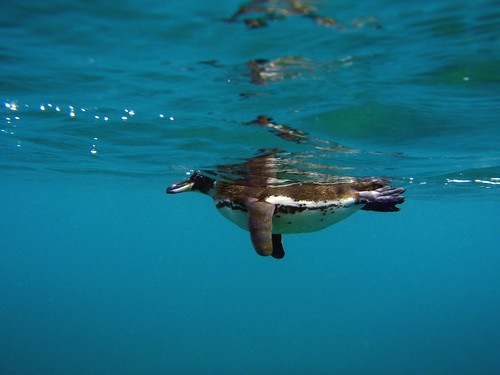
I had taken my head out to talk to some of my fellow Cachalote passengers, when I heard the unmistakable call of a Galapagos Penguin**--it sounds like a little lamb looking for its mother.  I shouted to my fellow passengers, "penguin!" and swam toward it.  And there it was, tiny head above water, occasionally dipping below the surface.  Just a few feet in front of me, and swimming toward--and then right past--me.  I can't express how incredible that brief moment was (it swam off at a speed I couldn't match within a minute or two).  Galapagos penguins are the northernmost penguins in the world--the only ones that ever travel north of the Equator.  This is one of the few places where you have the opportunity to swim around with a little snorkel and mask, and look up to see the world's most adorable flightless waterfowl paddling your way, taking its head out of the water and calling out for a compatriot of the same species.

I lined up my camera, and had the penguin perfectly centered in the frame.  What I, infuriatingly, didn't realize until a few minutes later is that my memory card was full.  For the first time on this trip, I had forgotten to make sure there was room on my camera before going off to do something of which I'd want pictures.  On the plus side, I found this picture that someone posted, which is almost exactly what I saw, though from the other side.  But I've been kicking myself for the last 48 hours.

It's worth noting that if I didn't already know that there were penguins here, I wouldn't have believed it.  When you're getting sunburns in 80 degree heat, you just don't expect to look out at the water and see a bird most commonly associated with Antarctica.  Of course, now that I know that there are Flamingos in the Andes (as well as here, by the way), I suppose I'm a bit less surprised by the spread of interesting birds.

Of course, the underwater inhabitants aren't the only fascinating thing about Galapagos.  After all, the birds are even more famous, and Darwin himself was most interested in the volcanic geology and fresh lava flows.  So it is that the most impressive fact of the Galapagos once one leaves the comforts of Puerto Ayora is how unspoiled it all is.  There is an extremely focused--and successful--effort to preserve the ecosystem and let it progress naturally.  So it is that one sees huge colonies of marine iguanas--swimming iguanas that exist nowhere else, solitary and enormous land iguanas, flightless cormorants--which have evolved into swimming birds with awkward and useless vestigial wings, enormous albatross, and thousands upon thousands of specacular blue-footed boobies--which live up to their name with nearly flourescent webbed feet.  These creatures don't really seem to care one way or the other about people, and so don't bother to flee when you approach, creating amazing opportunities for observation and picture-taking.  I've been in Galapagos for a week and a half now, and I'm still having a hard time believing this place is real.  When people ask how it is, I have a hard time saying anything other than "almost fictional."  It really just seems like someone's imagined version of a wildlife paradise.

Before I head off to figure out my plans for my last week on the islands, I want to take a moment to thank Juan Tapia, the spectacular guide who led our Cachalote group around several islands for the last week.  Juan has 21 years of knowledge crammed into his brain, and he shared a sizeable amount of it with us.  He knew exactly when and where to take us so that we almost completely missed the other tour groups.  If you look through my pictures, you will rarely see anyone other than Juan or one of the other five Cachalote passengers.  If you ever make your way down to Galapagos, hope that you're lucky enough to get a guide as excellent and professional as Juan.  And if you bring along a guitar, you might--as we did--be able to get him to play you "Besame Mucho."

At any rate, although I'm still recovering from the last week aboard the Cachalote--sleeping on a sailboat for a week means that sleeping on shore again feels like you're rocking back and forth--I should get going and figure out what I'm going to do for an encore.  It's going to be hard to top the last week--completely unique in my life to date--but I now have a great deal of confidence in the endless array of surprises that lay hidden in the various corners of these incredibly special islands.

Saludos,
Seth

*As of this writing I have a bit fewer than half of my pictures uploaded, and none of the videos.  Internet is very slow out here, so most of this will likely have to wait until I've returned home to the states.

**One thing that our group observed is that there's an easy way to guess the name of the species of animal you're looking at.  It's almost certainly the Galapagos _______, where the blank is filled in with the type of animal it is.  See also the Galapagos Hawk, Galapagos Shark, Galapagos Land Iguana, Galapagos Marine Iguana, Galapagos Tortoise, Galapagos Flightless Cormorant--with which I also swam, Galapagos Cotton (the plant), and so on.  These islands are so isolated that so many species of life here have evolved completely separately from their counterparts in the rest of the world.

Fotografía:


Galapagos - Española - Gardner Bay

Galapagos - Española - Punta Suárez

Galapagos - Floreana - Champion Rock

Galapagos - Floreana - Punta Cormorán

Galapagos - Floreana - Post Office Bay

Galapagos - Isabela - Punta Moreno

Galapagos - Isabela - Elizabeth Bay

Galapagos - Isabela - Urvina Bay

Galapagos - Fernandina - Punta Espinosa

Equator

Galapagos - Santiago - James Bay

Galapagos - Bartolomé

Galapagos - Santa Cruz - Black Turtle Cove

Thursday, April 22, 2010

Blogopagos - Living in a zoo

I'm at the bar at the Sol y Mar hotel in Puerto Ayora on the island of Santa Cruz, in the Galapagos.  The bar is in the back, and has a small pool and a deck which faces out into Pelican Bay--named for the many pelicans who live here and feed on the fish.  There's actually a pelican standing on the deck immediately adjacent to the pool, enjoying some shade, but no one's paying him much attention.  That's not actually surprising.  It's easy to miss a preening pelican when there's a sea lion swimming in the pool.


I've been here three days now, and easily the most striking thing is the total indifference of the animals to the humans around them.  The sea lions, in particular, are happy to put themselves anywhere that there's shade, whether that means on a bench or next to a table at the bar.  Some of the smaller finches and lava lizards might freak out and flee when approached, but one can walk right up to a sea lion, pelican, marine iguana, or giant tortoise without scaring it away.  Although there is now a decently-sized human population living out here--Puerto Ayora has over 10,000 inhabitants--it still has the feel of a place that evolved over the course of millennia free of human contact.  The Galapagos dove, which is basically a pigeon with a piercing blue circle around its eyes, was described by Darwin as being so oblivious that "I could kill by throwing my hat at it."

The animal that has actually captured my attention more than any other so far is the frigatebird.  It's rather large, with a wingspan similar to that of a vulture or some other large bird of prey.  Among the frigatebird's methods of obtaining food is a technique called kleptoparasitism.  In this, the frigatebird will identify another (smaller) bird--let's say a gull--who has just eaten, and harrass said gull until the it vomits.  Sometimes this involves catching the gull by the tail and shaking it aggressively in the air.  The frigatebird will then eat the regurgitated meal, taking the needed nutrients for itself.  Nature, as they say, doesn't fuck around.

The islands have a massive number of species of plants and animals that are endemic, meaning they don't exist anywhere else.  One of these is a form of prickly pear cactus that grows as a tree, and mostly appears along the coastline.  I'm still trying to figure out how to incorporate such a thing into my conception of reality.  I'm not there yet, but I'm getting close.

Another well-known group of endemic species is the finch family.  They're generally not that exciting to look at--they're quite small and the coloration isn't particularly thrilling.  But, given that they're the very birds that contributed so significantly to the development of Darwin's theory of natural selection, they end up being rather captivating.  What's funny, however, is that Darwin came here far more focused on the geology of the place--it's basically a big series of volcanos.  In fact, he barely even collected any samples of finches--just two of the thirteen or so species.  It was not until he got back to England that he realized what he had seen, and had to borrow samples from Robert FitzRoy, the captain of the HMS Beagle.  Accidental though Darwin's realizations may have been, it's fascinating and wonderful to be in the place responsible for them, and to witness firsthand the amazing biodiversity of an ecosystem left to evolve more or less on its own for thousands of years.

This evening I'll be boarding a schooner for a six-day cruise around the islands.  I'm expecting to see a lot of amazing things, and hoping to avoid letting the boat treat me like a frigatebird treats a gull.  I'll check back in when I'm back on land.

Saludos,
Seth

Fotografía:

Galapagos - Santa Cruz

Friday, April 16, 2010

Whoa-i Moai

I'm writing this from the Santiago airport, waiting for my flight back to Buenos Aires after spending the last three days on the island of Rapa Nui, more commonly known as Easter Island.  If there was any concern I'd be jaded about travel after the last three months, it was quickly dismissed.  You're most likely to know Easter Island as the site of giant stone heads (called "moai")*, and they do feature prominently.  I was thrilled to discover, however, that the island brings so much more to the table.


Rapa Nui, the name for the island in the local Polynesian dialect (called Rapanui), which is spoken by the native people (also called Rapanui) is an enchanting place.First off, the setting is unreal.  The island is the most isolated inhabited place in the world.  The closest airport is Santiago, and that's a five hour flight.  You can drive right along the coast until you find your way back to the same place (within only an hour or two), you will never see anything but ocean out one side.  My friend Mark, a Dubliner I met on the island, noted that you could easily see how the island's original inhabitants might have thought their little island was the entire world.

Easter Island was formed by several underwater volcanoes erupting together, leaving over 100 volcanoes, craters, vents and the like above ground.  Three major volcanoes, all extinct, have spectacularly beautiful crater lakes at the top.  The ancient lava flows also created a number of natural caves, many of which housed native Rapa Nui for over 1,000 years, and as recently as the 1950s.  The culture of the island had actually already been decimated by warfare and rapid population growth before Europeans first found it in the 18th century.  Many people lived in caves for protection, hiding from rival groups and even cannibals.  These days, one can go into several of the caves and look around, contemplating an existence so completely different from our own.  Amusingly enough, the two caves that I visited with Mark and his girlfriend Sarah had architectural features that would make them highly sought after in the New York real estate market.  One had two windows out of a cliff, looking out onto the ocean.  The other had several openings in the ceilings--skylights, if you will--which enabled vegetable gardens.  Crawling into the first of the two, the Caverna de las dos Ventanas, was a bit claustrophobic at first, but well worth it once we got to see the view from the living room.

Rapa Nui may not have an abundance of megafauna to compare with, say, Patagonia or the Galapagos, but it's far from a barren wasteland.  There are falcons everywhere.  You cannot drive along a road without seeing several hanging out on fenceposts, or zipping past your driver-side window.  Along the coast one sees frigate birds, which are enormous and majestic.  By far the best thing I got to see, however, was a family of sea turtles who came up to the beach to feed on fish.  My sister-in-law Shirley wouldn't agree with me (she thinks, accurately I'll confess, that turtles look like old men), but they were majestic and beautiful, and fascinating to watch.

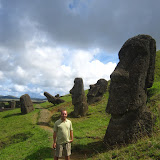
The main draw of the island is, of course, its archaelogy.  The moai are absolutely enormous--generally about 3-5 times my height, and weighing as much as 100 tons.  Historically, they stood on ahu--stone altars that were usually built along the coastline.  The moai faced inland to watch over the people and protect them.  Many of the moai also have pukao, which are red hat-like stones that are believed to represent a fashionable hairstyle from the time.  Over time, the warfare that wiped out most of the population combined with the occasional natural disaster to topple all of the moai from their perches.  These days some 40 or so moai have been restored to their original positions.

Although a decent amount is known about how the moai were made--they were cut from the volcanic rock at Rano Raraku volcano--and they were apparently hoisted to their platforms over several days with ramps made from logs, no one knows how they were moved from the site of their construction to their locations on the ahu.  In some cases they were moved as far as 10 miles, so this particular mystery is a truly impressive one.  Perhaps as impressive is the fact that some 320 moai were under construction at Rano Raraku (known as the "nursery") at the time construction was ceased.  The nursery is the site of most of the largest moai ever made, as well as most of the iconic images of Rapa Nui, with the heads of various moai sticking out of the ground, the torsos buried below while the faces were detailed.

An additional feature of interest is the cult of the bird man, believed to be the deity responsible for bringing bird life to the island, which happened many years after the arrival of people.  There are a number of petroglyphs around, many of them featuring the birdman.  The major annual ritual of the cult involved a swimming race to a rocky crag three kilometers off shore to search for the eggs of the sooty tern.  The first man to return with an egg would be crowned bird man for the following year.

The bird man cult, it's worth noting, is from the last few hundred years.  And that highlights one of the island's most intriguing characteristics: although the moai look as old as time itself, and have the feel of ancient mysteries, the entire Rapanui culture is barely a thousand years old.  They are certainly old, but while the moai were being built, for example, Europe was experiencing the rennaissance and exploring the globe.  In Asia, meanwhile, Genghis Khan was conquering civiliations and repopulating the entire planet with his own DNA.  But Rapa Nui was still literally living in the Stone Age.  I don't meant this as an insult of the Rapanui culture--which has some beautiful songs and dances, and which obviously pulled off some remarkable feats.  Rather I mean to highlight the force of extreme isolation with which the Rapanui had to contend.  Stranded so far away from the rest of the world, and facing the dilemma of an increasing population fighting for decreasing resources, it's no wonder that so many people were lost, taking so much history with them.

So, quite simply, Easter Island is a fascinating and multifaceted jewel dropped into the middle of the ocean.  It's a place that makes you ponder deep questions like the vastness of the planet and the ephemeral nature of civilizations, and it gives you an idyllic environment in which to do so--with a plentiful supply of delicious fish to make it all a little easier to handle.  By the time I post this, I will have landed back in Buenos Aires, having left behind what felt a bit like a three-day dream.  On Saturday I'm off to Guayaquil, Ecuador, before continuing on to the Galapagos on Sunday to begin the final portion of my journey.  It's hard to believe I'm so close to the finish line, but I'm thrilled that Rapa Nui has made it clear just how much I can still be enthralled and amazed by the world around me.

Saludos,
Seth

*If you're like me, the moai conjure up images of both Marty Sherman's classmate on The Critic, or some bad guys from Super Mario Land for Gameboy.  But you're probably not like me unless you're my brother, you're probably not like me.

Fotografía:

Sunday, April 11, 2010

Bloga Juniors Dos - El Fulgor Argentino


I have arrived in Easter Island, a land which can easily make one feel like Super Mario. However, my hostel has no internet, which means you'll be seeing this a good deal after I write it. Travel is complicated like that, especially when it involves trying to connect to the global community from the most remote inhabited place on Earth. At any rate, the subject of this post is not Easter Island (I got in after dark, so I haven't seen any moai--giant heads--yet), but rather my most recent night in Buenos Aires.

Last night I had the great pleasure of attending a work of Argentine community theater, called Club Social y Deportivo El Fulgor Argentino. The show was at Teatro Catalinas Sur in La Boca, and had some truly excellent props assembled by my friend and fellow Wesleyanite Hannah Nielsen-Jones. Hannah and her boyfriend John have been living in BA for a while, but we only just managed to get together this week. They are truly awesome people, but I'll come back to them in a bit.

The show was excellent. I tend to be pretty jaded about all things theater, but this was really everything it should be. The piece is a revue of Argentine history from 1930-2030 (the future part is pretty crazy), with the country represented by El Fulgor, a social and sporting club of the type that is quite prominent in Argentine society. It's a musical with a cast of over 100 performers, very creative songs and staging, and phenomenal costumes. It also features some astonishing puppetry--puppets made by the same guy who does most of the lifesize statues (muñecos, in Spanish) in La Boca--executed in truly creative ways. For example, there is a sequence in which the whole group dances Tango in a circle, each pair made up of one person and one puppet, connected at the feet, so that the puppets' feet move in synch with those of their partners. There is another moment in which an actor appears in military garb with a puppet on either side, connected both at the arms and the head, so that they mimic his every move. It is really something to behold.

In a lot of ways, my enjoyment of the show mirrors my enjoyment of Uruguayan Murga. In addition to having moments in which the musical style was similar--the finale, in particular--I was most impressed by the wholehearted commitment of everyone involved, and the degree to which this is really just a labor of love for the local culture. The cast is all volunteers, and the logistical nightmare that must be involved in coordinating so many people in something so complex is totally obscured by the seemless transitions on stage. It's clear that everyone involved has put a tremendous amount of sweat into the project, but seeing them perform gives the impression that they were all born into the script.

I was also particularly happy because this was the most accessible Argentine culture has felt for me in Buenos Aires. It is easy to feel that there is a Buenos Aires for the locals, and a separate one for the tourists. Certainly New York can be like that, so I don't mean this as a criticism. But even something like tango, which is a major part of the cultural history of the city, often shows up in a form that feels somewhat camped up for the sake of the out-of-town crowd. At El Fulgor, those feelings washed away. I don't know that anyone there other than Hannah, John, John's parents, and me spoke English--certainly not as a first language. I finally felt a part of the city in exactly the way I had been looking for and struggling to find. So, a hearty thank you to Hannah and John for inviting me to share in that.

And now that I've come back to the subject of how awesome Hannah and John are, I have to say that it was really great to see a familiar face. What's funny is that I hadn't seen Hannah in six years, and I'd never met John. So there's no reason it should have been that different from spending time with the various friends I've made throughout the trip. But one thing that does happen when you're meeting new people and making new friends is that you inevitably have your guard up a bit--no matter how awesomely down-to-earth your new friends may be. So it was just incredibly relaxing to be in a spot where I had even the slightest sense of home. I even felt that way after we discussed the most academically intimidating class I ever took, Colonialism and its Consequences in the Americas*. At any rate, it's really remarkable how valuable a bit of familiarity can be after a three-months of new experiences. And, to repeat, Hannah and John = good people.

There's a three-hour time change that I'm dealing with now, so I'm going to go to sleep. Hopefully I'll be able to find some time to post this, and presumably by the time that happens I will already have seen some giant stone heads. I've been working on my moai impression, so hopefully I can break that out soon. For now, I'm going to work toward an early start tomorrow.

Saludos,
Seth

*My struggles in that class forced me to confront how unseriously I took academic study, and, to an extent, myself. I still think it's good not to get too wrapped up in oneself, but I've at least gotten the intellectually serious thing down--or at least some semblance thereof.

El Fulgor Argentino

Monday, April 5, 2010

Hielo, how are you*

Yes, that is a glass of scotch with glacier ice in my hand

I'm sitting at my computer in Bariloche and loving the fact that I live in an age in which I can watch the Mets on opening day even though I'm several thousand miles away.  I figured I'd take advantage of the few hours I'm spending in front of a screen and check in.  I don't have much big-picture stuff to say, so I'll just go through some of what I've been up to and what I've been thinking lately.
  • The other day I went to Perito Moreno glacier, in El Calafate, Argentina.  Lonely Planet describes Perito Moreno as "to ice what Iguazú is to water," and that's pretty accurate.  It's absolutely immense.  It is comprised of nine cubic miles of ice.  Let that marinate for a moment.  If you made it into a block a mile high, the base would be three miles by three miles.  If you covered the island of Manhattan with the ice from Perito Moreno, it would be a little over 2,000 feet high (the Empire State Building is less than 1,500, including the spire).  What happens is that cold winds pick up water vapor over the Pacific, and then dump it down into the ice field as snow.  Over time, the snow is compacted into ice.  The weight of the new snow on top pushes the old ice downhill, which is part of why the glacier is actually advancing at a rate of about six meters a year.  I've already discussed glacier calving a bit, and Perito Moreno is particular famous for calving.  In the two hours I was there, I saw three utterly enormous blocks of ice come crashing into the water below.  The calving occurs because water running at the foot the glacier melts pockets of ice and destabilizes the front of it.  In this particular instance, the calving is a naturally-occurring phenomenon that has nothing to do with global warming.  Perito Moreno is actually a stable glacier, due in large part to the heaping piles of snow constantly deposited at its source.  When you're looking at the glacier from the viewpoints, you just see ice stretching back as far as the eye can see, up into the mountains and disappearing into the clouds.  I've said it before, but I'll repeat it here: Nature is humbling.
  • I'd like to follow up on that point about the computer age at the top of the post.  Technology is absolutely amazing.  It is quite literally magic.**  We don't really think about that because we're so accustomed to it, but it is.  If you went to someone from a thousand years ago and said "there is this energy in the universe, consisting of particles too small to see, and I have a device that can manipulate them and allow me to see, hear, and speak to my family in real time from a continent away," they would accuse you of sorcery, and they would be right.  We may not be using wands and encantations, but we're capable of interacting with the world around us in many of the same ways as Harry Potter and the kids at Hogwarts.
  • I've never been huge into ornithology, but this trip is making me into a serious bird-lover.  The variety in Patagonia is unbelievable, and big.  In the last week, I have seen penguins, condors, flamingos, rheas (sort of like an emu), a (huge) woodpecker, and an eagle.  I always thought of flamingos as tropical birds, but apparently the Chilean Flamingo is perfectly content in weather that has me wearing two sweaters under my coat.
  • My Spanish has progressed to the point that when someone asks me "hablas español" (or, in Buenos Aires, "hablás español"), I say "sí."  I can usually get through a conversation without much trouble, and can get information I need or ask an important question confidently.  I even know all twenty grammatical tenses (of which they only really use sixteen).  Sometimes, however, I run into issues where I'll just come across a pretty simple word I just don't know because I've never encountered it for one reason or another.  One of the things about learning a language in an intensive fashion is that you can easily end up being rather competent, but with big and unexpected gaps.  This leads to some exchanges like the one I had while hiking around Torres del Paine last week (entire exchange translated into English, but originally spoken in Spanish):
    Seth: How's it going? Dude: Good, thanks.  Do you know how far it is to the Torres campground? Seth:  Hmm, you still have a while left.  It's probably four or five hours.  There's a refuge before that, but it's closed for the season.  You can still camp there in a tent, but the refuge itself is closed.  It's only another hour from there to the campground though. Dude: Okay, thanks.  How's the hike Seth:  It's not too bad.  In your direction it will probably be a bit harder, because you're going uphill.  Coming downhill was pretty nice.  It's not that steep though, it's mostly pretty flat.  Though there are some hills toward the end.  There's also a lot of... what's the word in Spanish... what's it called when dirt and water mix? Dude: Mud. Seth:  Mud, ok.  There's a lot of mud.
    Point being, I could carry on the entire conversation and express a great deal of detail, but I had just never come across the word for "mud" (which is "barro," by the way).  This, of course, is how you learn both where your deficiencies are and how to correct them.
  • The point at which I decided to give up and turn in from my attempted four and a half day hike around Torres del Paine was very precise.  I was on my way to the Refugio Los Cuernos, which is a refuge in the middle of the park, and having a rough time with the hills.  I came to a sign that had a little star with  "you are here" written next to it, and which had a line from there to Los Cuernos that said 2km.  "Okay," I thought.  "I can do two kilometers.  That's not a whole lot more than a mile, even if some of it is uphill."  A little while later, I came to another sign that was similarly structured, but had the 2km on the right, and a new number, 2.6km on the left.  It turned out that the previous sign had just been telling me "it's two kilometers to the next sign."  It was at this point that I shouted some obscenities at the sign, decided that I had had enough, and then walked the remaining two hours to Los Cuernos.  I had another 5 hours to walk the next day, but I made it.  As a follow-up, my ankles are feeling a lot better, though the occasional mis-step hurts a lot more than it normally would. 
  • Something I've noticed is that crossing borders repeatedly and quickly can get pretty confusing.  It was tough enough when I spent half a day in Brazil and had to struggle with a language of which I know less than even Greek, Czech, or Hungarian (in all of which I know how to say "thank you.").  It turns out though that even if it's a country that speaks the same language, it can get a little tough.  I spent about a week in Chile, never more than a few hours from Argentina (granted that describes the entire country). But adjusting to the currency, and even more, to the accent, has really thrown me for a loop.  I spent a month and a half getting accustomed to Rioplatan Spanish (pronouncing "y" as "sh" and using "vos").  When I went to Chile, it was surprisingly easy to slide back into the more familiar style I'd always known.  But coming back into Argentina has completely messed with me.  I will now literally change accents and grammatical structures mid-sentence, with no rhyme or reason.  What's more, I'm here for a week and then I'll be going back to Chile, so it's likely to get more confusing before it gets easier.
  • I haven't seen that much of Bariloche yet, but I'm excited about the food.  Venison and boar are local specialties here, and it's the chocolate capital of South America.  Moreover, Helados Jauja is purported to have the best ice cream in all of Argentina.  I had a cone earlier today and there's a very good chance the claim is accurate. I had two flavors (you always get two flavors): maqui*** with sheep's milk, and raspberry-mascarpone.  This was even better than the calafate-berry ice cream I had in El Calafate.  I'm very happy.
  • I'm currently sitting in the lounge in my hostel, and there's music on.  This is nice, and it is pleasant.  However, some dude and his girlfriend have come in with an ipod and mini-speakers, and are now blasting music from the other side of the room through some tinny-sounding tubes, and it is competing directly with the music that's already in the room.  The music on the stereo right now is Radiohead.  The ipod is playing some schmaltzy songstress I don't recognize.  These things do not mix well, and it's extremely irritating.  Please: if you go to a hostel, don't be that guy.  That guy is a jerk.
The Mets have dispatched the Marlins 7-1, continuing their tradition of being a much better team on opening day than on the other 364 days out of the year.  But Jeff Francoeur took a walk, so I'm trying to stay optimistic.  And Peñarol is 11-0-0, so my backup interest of Uruguayan soccer is at least shaping up pretty well.  I'm going to go explore Bariloche.  I still need to try the chocolate, and I'm almost definitely going to make it a two-cone day.

Saludos,
Seth

*"Hielo" is Spanish for "ice."

**I will abashedly admit that I started thinking about this point when I read it in Dan Brown's "The Lost Symbol," which I read while I was in Costa Rica.  It is hardly a high-brow work of fiction.  It is, in fact, candy in book form, and not even as flavorful a candy as Brown's first two books.  But I do think that on this particular subject it has an unexpectedly good point to make.

**Maqui is a Patagonian berry that, according to one website, has more antioxidants than any other berry in the* world.  I don't know if that's true, but it tastes really good.

Fotografía:
Perito Moreno Glacier

Reserva Laguna Nimez

Friday, April 2, 2010

Yo no soy mochilero

Backpacking is hard.  This is what I've learned.  I don't mean backpacking as in just traveling with a backpack, the way I've been doing it for the last three months.  I mean backpacking as in hiking around a park with all your food, clothing, and lodging on your back.  Climbing things can be exhausting.  Doing so with an extra 40-50 pounds can result in some serious pain.


For me, this trip is about exploring my own abilities and sensibilities as much as it's about exploring the world around me.  It's also about finding my limits.  Having already hiked up a Nicaraguan Volcano in sandals, I had begun to forget that my limits existed.  I'm in pretty decent shape--or, I oscillate between very good shape and very bad shape, so I average out to decent shape--so I figured a five day hiking trip through a national park might be a bit challenging, but certainly something I could get through.

What I learned, instead, is that my backpacking limit is 25 miles.  That's how much I walked (probably a bit more actually) over the course of three days before I headed back.  A lot of it was over very hilly and rocky terrain, but a decent amount was flat as well.  Plenty of it was up some steep inclines, but there were long stretches of coasting downhill to balance it out.  I don't doubt that with a bit of training, I could get myself to the point where I could get through the entire trip, but this time it wasn't in the cards--walking just hurt too much.

I can certainly place some of the blame for the pain I was experiencing on my having the world's flattest feet.  I can place a bit more on the fact that I tend to shuffle more than stride when I walk, and the fact that my backpack was a bit too large for me, leaving too much weight on my back and shoulders, and not enough on my hips.  But ultimately, whatever the case, the full W wasn't happening.  I gave it my best shot, even continuing through day two after having serious doubts on day one.  The conclusion that I ultimately reached is that while leaving would have been giving in to the pain, continuing would have been giving in to stubbornness.  My feet were killing me.  Every step hurt.  And though I was seeing some amazing things, it had gotten to the point where I felt I was risking the rest of my trip if I didn't pack it in and grab the boat and bus back to Puerto Natales, and give my weary legs some rest.

I have newfound respect for hikers and backpackers ("mochileros" in Spanish--hence the post's title).  I never knew that walking could require such cardiovascular endurance and muscular strength.  There's also the rather complicated science of figuring out how to carry just enough food to eat without weighing yourself down.  I'm grateful that I was able to head out there with my new friends Todd and Valerie--with whom I've now eaten both the best and the worst meals of this trip.  I met Todd and Valerie on the boat, and they were really patient and wonderful about taking me through the fundamentals of trekking, and making sure we stuck to a leave-no-trace philosophy, taking all our garbage with us.

I will say that Torres del Paine is a truly spectacular place, and I only saw one of its three major attractions (though it also has countless spectacular vistas sprinkled along a wide variety of trails).  The actual Torres del Paine are granite towers that rise up out of the very glacier that formed them, with small trickles of water flowing down the base and pooling in a lake at the bottom.  The entire structure is about 2,000 meters (about 6,600 feet) above the viewpoint, which is itself 800 meters (2,600 feet) above ground level.  The most impressive thing about it when you're up there is realizing just how far away you still are from the peaks themselves.  It feels like you're right there, and then you see a waterfall coming down from the glacier at what looks like a snail's pace, and only then do you recognize that the entire thing is actually too big to truly comprehend.

The rest of the park includes a seemingly endless array of glaciers, all of which flow down a variety of deliciously drinkable streams and rivers and create some of the most startlingly electric blue lakes I've ever witnessed.  The water is anything but clear, but it nonetheless manages to look pristine--the obscurity is, after all, from mineral content, not pollution.  I also had the opportunity to witness an avalanche (from a safe distance), as a big chunk of snow up on the Glaciar Francés dislodged itself and came crashing down into the valley below.  In all, I was constantly reminded of something Todd said when we saw our first glaciar from the boat down in Tierra del Fuego: nature is humbling.  Few things will remind you of your own impermanence like seeing a multi-million year-old block of ice do something that could crush you like a mosquito, without any kind of guiding hand.

I didn't get to see a whole lot of wildlife--although a brush with a puma track was as close to one of those as I'd like to get.  I saw a Magellanic woodpecker and a few Andean condors, though, which was enough to keep me happy.  The condor, which is extremely endangered, is the bird with the biggest wingspan in the world, but it flies so high up in the sky that it's sometimes hard to remember that.  It's pretty awe-inspiring however, and it's easy to see why the Inca people revered the condor as a symbol of the heavens.  I'm still waiting to see my first guanaco (an alpaca-like creature that's common down here) and my first rhea (sort of like an emu).  I'm hopeful I'll manage a sighting of one or the other on the bus tomorrow.  On the plus side, I did get to see one of the most spectacular rainbows I've ever witnessed.

So now I'm taking it easy in Puerto Natales, ancient home of the mylodon, and feeling a bit like a giant ground sloth myself.  I've spent the last two days doing a minimal amount of walking, trying to make sure I'm not hobbled when I get to Perito Moreno glacier--the next mind-boggling experience I have on tap.  In the meantime, I'm enjoying what the small town of Natales has to offer--namely a really good chocolate shop, some cormorants and black-necked swans, and a very interesting African-Chilean restaurant.  Between the failed hike and some other logistical issues, I was a little grumpy yesterday, but I reminded myself to be tranquilo, and that this trip is much more marathon than sprint.  It's easy to get caught up in the moment, but just this morning I met some Americans who are doing a study abroad program in Santiago, and their entire semester of study is shorter than my trip (it started later and will end earlier).  So it's certainly important for me to take all the hiccups in stride (I'm looking at you, DHL).

I'm still in the process of uploading the final pictures from the boat, to say nothing of the pictures from Torres del Paine.  For now, however, I'm going to pay for my Cafe Chileno (coffee with pisco) and make sure I'm all set for tomorrow.

Saludos,
Seth

Fotografía:
Torres del Paine

Punta Arenas and Puerto Natales

Sunday, March 28, 2010

Fjordy Days and Fjordy Nights


I'm back on terra firma after three days spent on a boat and off the radar.  My mind is officially blown.  The things we saw were absolutely spectacular, and I'm realizing that I'm rapidly running out of superlatives to describe my experiences on this trip.  I think I have a lot less insight to offer into things when it's just "this naturally-occuring phenomenon is awesome" and there's not any cultural stuff involved, but I'll take you through my time aboard the Mare Australis.

The first day began with a sunrise stop at Cape Horn, the southernmost point in the world--not including Antarctica.  The view from the largely unspoilt cliffs of Isla de Hornos out over the vast southern seas was one in a long string of glimpses of the humbling power of nature.  From there we headed over to Wulaia Bay, where we disembarked and hiked up a hill to a viewpoint.  It was up there that I turned to Todd and Valerie, possibly the only other people on the boat traveling with a backpack, and said "yeah, I think I'm starting to understand this whole Patagonia thing."  I took some massive panoramic photos up there if you're curious as to what I mean.

Wulaia Bay also offered some excellent wildlife sightings.  Patagonia is one of the few places in the world where the most aggressive resident is Canadian.  And indeed, on the way up the hill, we saw many telltale signs of beavers, and eventually caught a glimpse of one swimming around its dam.  Beavers were brought to Patagonia from Canada over 100 years ago in the hopes of giving the area a fur industry as strong as its wool trade.  Apparently, however, beaver fur requires stressed-out beavers--the adrenaline makes the fur usable somehow through the magic of endocrinology.  The beavers in Patagonia found the region much more accommodating than Canada had been, and instead of providing a stressed-out foundation for the economy, they grew from a population of 50 to about 50,000.  Seriously people.  Stop bringing invasive species to places because you think you're smarter than millions of years of evolution.  I don't care how adorable they are.  It messes things up.  Though, that said, the beaver was adorable.  On the zodiac boats back to the ship (yes, I do feel like a character from LOST), a few dolphins swam around us and jumped around in the water.  I got one decent video of them and a whole lot of videos of looking for them.

Day two involved a drip to the Alacalufe Fjord in Chico Inlet, where we got to take zodiacs over to Nena and Piloto Glaciers.  This was where I learned that glaciers and the fjords they create are some pretty impressive geographical formations (understatement alert).  What's completely daunting is the total loss of spatial perspective.  You sit in a boat next to this enormous thing, but you're far enough away that it's tough to tell how far away you are, and just how massive the thing is.  Our guide said the glacier runs about 1800 meters up to an ice field.  It's basically the world's largest freezer.

The glaciers were comprised of mostly blue ice--meaning that the ice is very old and has spent centuries being compacted by the glacier's enormous weight.  On that particular day, there had been a tremendous amount of calving, which happens when part of the ice underneath melts down, and the glacier can't support the weight of a large chunk, which falls into the water.  The water was so full of icebergs it looked like you could get out and walk.  In some places, you probably could.  There were icebergs twice the size of our zodiacs (which hold about 14 people each) that had apparently fallen off the glacier earlier in the day.  We got to see a small amount of calving, as a piece about 3-5 feet high fell off and landed with an astonishingly thunderous crack.  Again, humbling.

The fjords themselves are extremely impressive.  The sheer basalt cliffs carved out over millenia look downright forboding, and the waterfalls cascading down in places from the ice fields on top give the whole thing an otherworldy feel.  In places, one can see moss, grass, or even small trees, giving a sense of how relatively long ago the glacier receded from a certain section of the rock.  The water that winds its way through is the most reflective I've ever seen--presumably relating to a high mineral content.  In a lot of places it looks like a mirror.  I tried to get some pictures that captured this, which came out okay, but suffice to say it's really an incredible phenomenon.  Remarkably, the ferociously salty and incredibly cold water has a very healthy jellyfish population.  I saw one from the boat that was a good two feet long.  I guess they're the ocean's cockroaches, durability-wise.

I'm fairly certain everyone who's reading this is intellectually honest enough to recognize the threat that global warming poses.  I just feel the need to mention that having now seen just some of the world's smaller glaciers, I realize not just how much more water that will mean in the ocean, but also what a magnificent thing it is that we're slowly losing.  Our guide told us that just in the last couple years since he started coming to these glaciers, they have receded immensely, melting and falling into the salty seawater, and it is truly a tragedy.

Our last stop was at Magdalena Island, home to a colony of 50,000 or so Magellanic Penguins.  This might sound a bit silly, but the thing that was most striking to me was, when you see them in the wild, just how clear it is that they are birds.  I note this simply because I remember being a kid and learning that penguins are birds and being completely confused.  But they waddle around like ducks, they have feathers and beaks, and they really just look like birds that haven't bothered to figure out how to fly.  They are also some of the loudest creatures I've encountered.  They wander around braying out loud--it sounds like donkeys--in the hopes of tracking down their monogamous partners.  To be clear, it's not to find a new mate, it's to get back in contact with the old one, who they sometimes lose in the crowd of 50,000 other birds that look almost exactly the same.  Somewhat amusingly, they mate for life unless they really just can't find their partner, in which case they find another.  They are also, as it happens, criminally adorable.

What's also pretty cool about Magdalena is that the penguins don't really care much about the human presence, so they'll just walk right by you.  If you're walking faster they'll run out of the way, but generally speaking they'll just sort of assume some unspoken terms of feigned mutual ignorance.  They're obviously wrong about whether we're paying attention to them, but that's another issue entirely.

I'm now in Puerto Natales in Chile, home of a giant ground sloth cave and the base for trips to Torres del Paine national park.  I am also hungry, so I'm going to do something about that.

Saludos,
Seth

Fotografía:
Cabo de Hornos - Cape Horn

Wulaia Bay

Alacalufe Fjord

Magdalena Island Penguin Colony

Wednesday, March 24, 2010

Tierra del Blogo

Today, for the first time in two and a half months it was colder where I was than it was in New York.  I arrived this afternoon in Ushuaia, the main hub of Argentine Tierra del Fuego.  Technically, Ushuaia is the southernmost city in the world.  I say technically because that relies on a strict interpretation of the word "city," as Puerto Williams is further south, but claims only 2,000 residents to Ushuaia's 64,000.  Whatever the case, it's far enough south to be pretty freaking cold, even as the Summer is just starting to turn to Fall.  Today was mostly in the 40s and 50s, which meant busting out the cold-weather wear that had been going mostly unused for the last few months.  Given that this trip was motivated in part by a desire to escape Winter, my decision to come down here initially caused me a bit of cognitive dissonance.  The rationale I ultimately settled on is that if you're going to be somewhere cold, it might as well also be pretty freaking amazing.  So far, so good.


Ushuaia is surrounded on all sides by jarringly jagged peaks that are draped with snowy glaciers.  The effect of this is that you end up with a surprisingly dramatic vista anytime you're looking down any street in town.  The town is built on a hill, with the top part at the northern end and the Beagle Channel--named for Darwin's boat--at the southern border.  The Beagle Channel's royal shade of blue forms a striking contrast with the gray, brown, and white peaks all around, meaning that one can just stand by the water and take in the beauty, and nearly forget that your hands are starting to feel a bit numb.

The main street in Ushuaia, San Martín, has a surprisingly familiar range of gear shops for outdoors activities.  Hiking and ski shops are more common than basically anything aside from food and lodging.  In a lot of ways, Ushuaia resembles a ski town in the states--at least in part because it's a ski down down here in the Winter.  It's pretty populous--much more bustle than, say, Penn Yan, NY, but most of the people are just here as part of the tourist economy, be it on the supply side or the consumption side.  There isn't much else to rely on, resource-wise.  Ushuaia gets most of their basic goods on boats from the mainland--Tierra del Fuego is an island, after all.  Most of the early population growth here came out of its service as a penal colony, and the prison remains a tourist destination (which I'll likely visit tomorrow).

I feel like I got through my Buenos Aires wall before I left, and started to appreciate it as a city that really does have a lot to do if you live there.  After spending much of my time there feeling sort of underwhelmed (and perhaps overwhelmed at the same time), I left feeling a bit sad to be leaving it behind, though obviously excited for this next phase of the trip.  Tomorrow I'll be starting a three-day boat trip down to Cape Horn* and then across the Magellan Strait to Punta Arenas in Chile.  I should have some time to explore a bit more of the Land of Fire before I go, but until then I need to get some shut-eye.  I doubt I'll have internet on the boat, so I suspect I'll check in a few days from now feeling amazed and seasick.

Saludos,
Seth

*Cape Horn is called Cabo de Hornos in Spanish.  This translates as "Cape of the Ovens," which is obviously different from the English meaning.  I'm not sure what the origin is, but if I find out I'll pass along the info.

**Tierra del Fuego means "Land of the Fire," an odd name for such a cold place.  It gets its name from when Magellan sailed through and saw the many fires the region's indigenous people lit to keep themselves warm at night.

Fotografía:

Tierra del Fuego