Showing posts with label Patagonia. Show all posts

Monday, April 5, 2010

Hielo, how are you*

Yes, that is a glass of scotch with glacier ice in my hand

I'm sitting at my computer in Bariloche and loving the fact that I live in an age in which I can watch the Mets on opening day even though I'm several thousand miles away.  I figured I'd take advantage of the few hours I'm spending in front of a screen and check in.  I don't have much big-picture stuff to say, so I'll just go through some of what I've been up to and what I've been thinking lately.
  • The other day I went to Perito Moreno glacier, in El Calafate, Argentina.  Lonely Planet describes Perito Moreno as "to ice what Iguazú is to water," and that's pretty accurate.  It's absolutely immense.  It is comprised of nine cubic miles of ice.  Let that marinate for a moment.  If you made it into a block a mile high, the base would be three miles by three miles.  If you covered the island of Manhattan with the ice from Perito Moreno, it would be a little over 2,000 feet high (the Empire State Building is less than 1,500, including the spire).  What happens is that cold winds pick up water vapor over the Pacific, and then dump it down into the ice field as snow.  Over time, the snow is compacted into ice.  The weight of the new snow on top pushes the old ice downhill, which is part of why the glacier is actually advancing at a rate of about six meters a year.  I've already discussed glacier calving a bit, and Perito Moreno is particular famous for calving.  In the two hours I was there, I saw three utterly enormous blocks of ice come crashing into the water below.  The calving occurs because water running at the foot the glacier melts pockets of ice and destabilizes the front of it.  In this particular instance, the calving is a naturally-occurring phenomenon that has nothing to do with global warming.  Perito Moreno is actually a stable glacier, due in large part to the heaping piles of snow constantly deposited at its source.  When you're looking at the glacier from the viewpoints, you just see ice stretching back as far as the eye can see, up into the mountains and disappearing into the clouds.  I've said it before, but I'll repeat it here: Nature is humbling.
  • I'd like to follow up on that point about the computer age at the top of the post.  Technology is absolutely amazing.  It is quite literally magic.**  We don't really think about that because we're so accustomed to it, but it is.  If you went to someone from a thousand years ago and said "there is this energy in the universe, consisting of particles too small to see, and I have a device that can manipulate them and allow me to see, hear, and speak to my family in real time from a continent away," they would accuse you of sorcery, and they would be right.  We may not be using wands and encantations, but we're capable of interacting with the world around us in many of the same ways as Harry Potter and the kids at Hogwarts.
  • I've never been huge into ornithology, but this trip is making me into a serious bird-lover.  The variety in Patagonia is unbelievable, and big.  In the last week, I have seen penguins, condors, flamingos, rheas (sort of like an emu), a (huge) woodpecker, and an eagle.  I always thought of flamingos as tropical birds, but apparently the Chilean Flamingo is perfectly content in weather that has me wearing two sweaters under my coat.
  • My Spanish has progressed to the point that when someone asks me "hablas español" (or, in Buenos Aires, "hablás español"), I say "sí."  I can usually get through a conversation without much trouble, and can get information I need or ask an important question confidently.  I even know all twenty grammatical tenses (of which they only really use sixteen).  Sometimes, however, I run into issues where I'll just come across a pretty simple word I just don't know because I've never encountered it for one reason or another.  One of the things about learning a language in an intensive fashion is that you can easily end up being rather competent, but with big and unexpected gaps.  This leads to some exchanges like the one I had while hiking around Torres del Paine last week (entire exchange translated into English, but originally spoken in Spanish):
    Seth: How's it going? Dude: Good, thanks.  Do you know how far it is to the Torres campground? Seth:  Hmm, you still have a while left.  It's probably four or five hours.  There's a refuge before that, but it's closed for the season.  You can still camp there in a tent, but the refuge itself is closed.  It's only another hour from there to the campground though. Dude: Okay, thanks.  How's the hike Seth:  It's not too bad.  In your direction it will probably be a bit harder, because you're going uphill.  Coming downhill was pretty nice.  It's not that steep though, it's mostly pretty flat.  Though there are some hills toward the end.  There's also a lot of... what's the word in Spanish... what's it called when dirt and water mix? Dude: Mud. Seth:  Mud, ok.  There's a lot of mud.
    Point being, I could carry on the entire conversation and express a great deal of detail, but I had just never come across the word for "mud" (which is "barro," by the way).  This, of course, is how you learn both where your deficiencies are and how to correct them.
  • The point at which I decided to give up and turn in from my attempted four and a half day hike around Torres del Paine was very precise.  I was on my way to the Refugio Los Cuernos, which is a refuge in the middle of the park, and having a rough time with the hills.  I came to a sign that had a little star with  "you are here" written next to it, and which had a line from there to Los Cuernos that said 2km.  "Okay," I thought.  "I can do two kilometers.  That's not a whole lot more than a mile, even if some of it is uphill."  A little while later, I came to another sign that was similarly structured, but had the 2km on the right, and a new number, 2.6km on the left.  It turned out that the previous sign had just been telling me "it's two kilometers to the next sign."  It was at this point that I shouted some obscenities at the sign, decided that I had had enough, and then walked the remaining two hours to Los Cuernos.  I had another 5 hours to walk the next day, but I made it.  As a follow-up, my ankles are feeling a lot better, though the occasional mis-step hurts a lot more than it normally would. 
  • Something I've noticed is that crossing borders repeatedly and quickly can get pretty confusing.  It was tough enough when I spent half a day in Brazil and had to struggle with a language of which I know less than even Greek, Czech, or Hungarian (in all of which I know how to say "thank you.").  It turns out though that even if it's a country that speaks the same language, it can get a little tough.  I spent about a week in Chile, never more than a few hours from Argentina (granted that describes the entire country). But adjusting to the currency, and even more, to the accent, has really thrown me for a loop.  I spent a month and a half getting accustomed to Rioplatan Spanish (pronouncing "y" as "sh" and using "vos").  When I went to Chile, it was surprisingly easy to slide back into the more familiar style I'd always known.  But coming back into Argentina has completely messed with me.  I will now literally change accents and grammatical structures mid-sentence, with no rhyme or reason.  What's more, I'm here for a week and then I'll be going back to Chile, so it's likely to get more confusing before it gets easier.
  • I haven't seen that much of Bariloche yet, but I'm excited about the food.  Venison and boar are local specialties here, and it's the chocolate capital of South America.  Moreover, Helados Jauja is purported to have the best ice cream in all of Argentina.  I had a cone earlier today and there's a very good chance the claim is accurate. I had two flavors (you always get two flavors): maqui*** with sheep's milk, and raspberry-mascarpone.  This was even better than the calafate-berry ice cream I had in El Calafate.  I'm very happy.
  • I'm currently sitting in the lounge in my hostel, and there's music on.  This is nice, and it is pleasant.  However, some dude and his girlfriend have come in with an ipod and mini-speakers, and are now blasting music from the other side of the room through some tinny-sounding tubes, and it is competing directly with the music that's already in the room.  The music on the stereo right now is Radiohead.  The ipod is playing some schmaltzy songstress I don't recognize.  These things do not mix well, and it's extremely irritating.  Please: if you go to a hostel, don't be that guy.  That guy is a jerk.
The Mets have dispatched the Marlins 7-1, continuing their tradition of being a much better team on opening day than on the other 364 days out of the year.  But Jeff Francoeur took a walk, so I'm trying to stay optimistic.  And Peñarol is 11-0-0, so my backup interest of Uruguayan soccer is at least shaping up pretty well.  I'm going to go explore Bariloche.  I still need to try the chocolate, and I'm almost definitely going to make it a two-cone day.

Saludos,
Seth

*"Hielo" is Spanish for "ice."

**I will abashedly admit that I started thinking about this point when I read it in Dan Brown's "The Lost Symbol," which I read while I was in Costa Rica.  It is hardly a high-brow work of fiction.  It is, in fact, candy in book form, and not even as flavorful a candy as Brown's first two books.  But I do think that on this particular subject it has an unexpectedly good point to make.

**Maqui is a Patagonian berry that, according to one website, has more antioxidants than any other berry in the* world.  I don't know if that's true, but it tastes really good.

Fotografía:
Perito Moreno Glacier

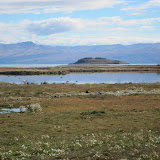
Reserva Laguna Nimez

Sunday, March 28, 2010

Fjordy Days and Fjordy Nights


I'm back on terra firma after three days spent on a boat and off the radar.  My mind is officially blown.  The things we saw were absolutely spectacular, and I'm realizing that I'm rapidly running out of superlatives to describe my experiences on this trip.  I think I have a lot less insight to offer into things when it's just "this naturally-occuring phenomenon is awesome" and there's not any cultural stuff involved, but I'll take you through my time aboard the Mare Australis.

The first day began with a sunrise stop at Cape Horn, the southernmost point in the world--not including Antarctica.  The view from the largely unspoilt cliffs of Isla de Hornos out over the vast southern seas was one in a long string of glimpses of the humbling power of nature.  From there we headed over to Wulaia Bay, where we disembarked and hiked up a hill to a viewpoint.  It was up there that I turned to Todd and Valerie, possibly the only other people on the boat traveling with a backpack, and said "yeah, I think I'm starting to understand this whole Patagonia thing."  I took some massive panoramic photos up there if you're curious as to what I mean.

Wulaia Bay also offered some excellent wildlife sightings.  Patagonia is one of the few places in the world where the most aggressive resident is Canadian.  And indeed, on the way up the hill, we saw many telltale signs of beavers, and eventually caught a glimpse of one swimming around its dam.  Beavers were brought to Patagonia from Canada over 100 years ago in the hopes of giving the area a fur industry as strong as its wool trade.  Apparently, however, beaver fur requires stressed-out beavers--the adrenaline makes the fur usable somehow through the magic of endocrinology.  The beavers in Patagonia found the region much more accommodating than Canada had been, and instead of providing a stressed-out foundation for the economy, they grew from a population of 50 to about 50,000.  Seriously people.  Stop bringing invasive species to places because you think you're smarter than millions of years of evolution.  I don't care how adorable they are.  It messes things up.  Though, that said, the beaver was adorable.  On the zodiac boats back to the ship (yes, I do feel like a character from LOST), a few dolphins swam around us and jumped around in the water.  I got one decent video of them and a whole lot of videos of looking for them.

Day two involved a drip to the Alacalufe Fjord in Chico Inlet, where we got to take zodiacs over to Nena and Piloto Glaciers.  This was where I learned that glaciers and the fjords they create are some pretty impressive geographical formations (understatement alert).  What's completely daunting is the total loss of spatial perspective.  You sit in a boat next to this enormous thing, but you're far enough away that it's tough to tell how far away you are, and just how massive the thing is.  Our guide said the glacier runs about 1800 meters up to an ice field.  It's basically the world's largest freezer.

The glaciers were comprised of mostly blue ice--meaning that the ice is very old and has spent centuries being compacted by the glacier's enormous weight.  On that particular day, there had been a tremendous amount of calving, which happens when part of the ice underneath melts down, and the glacier can't support the weight of a large chunk, which falls into the water.  The water was so full of icebergs it looked like you could get out and walk.  In some places, you probably could.  There were icebergs twice the size of our zodiacs (which hold about 14 people each) that had apparently fallen off the glacier earlier in the day.  We got to see a small amount of calving, as a piece about 3-5 feet high fell off and landed with an astonishingly thunderous crack.  Again, humbling.

The fjords themselves are extremely impressive.  The sheer basalt cliffs carved out over millenia look downright forboding, and the waterfalls cascading down in places from the ice fields on top give the whole thing an otherworldy feel.  In places, one can see moss, grass, or even small trees, giving a sense of how relatively long ago the glacier receded from a certain section of the rock.  The water that winds its way through is the most reflective I've ever seen--presumably relating to a high mineral content.  In a lot of places it looks like a mirror.  I tried to get some pictures that captured this, which came out okay, but suffice to say it's really an incredible phenomenon.  Remarkably, the ferociously salty and incredibly cold water has a very healthy jellyfish population.  I saw one from the boat that was a good two feet long.  I guess they're the ocean's cockroaches, durability-wise.

I'm fairly certain everyone who's reading this is intellectually honest enough to recognize the threat that global warming poses.  I just feel the need to mention that having now seen just some of the world's smaller glaciers, I realize not just how much more water that will mean in the ocean, but also what a magnificent thing it is that we're slowly losing.  Our guide told us that just in the last couple years since he started coming to these glaciers, they have receded immensely, melting and falling into the salty seawater, and it is truly a tragedy.

Our last stop was at Magdalena Island, home to a colony of 50,000 or so Magellanic Penguins.  This might sound a bit silly, but the thing that was most striking to me was, when you see them in the wild, just how clear it is that they are birds.  I note this simply because I remember being a kid and learning that penguins are birds and being completely confused.  But they waddle around like ducks, they have feathers and beaks, and they really just look like birds that haven't bothered to figure out how to fly.  They are also some of the loudest creatures I've encountered.  They wander around braying out loud--it sounds like donkeys--in the hopes of tracking down their monogamous partners.  To be clear, it's not to find a new mate, it's to get back in contact with the old one, who they sometimes lose in the crowd of 50,000 other birds that look almost exactly the same.  Somewhat amusingly, they mate for life unless they really just can't find their partner, in which case they find another.  They are also, as it happens, criminally adorable.

What's also pretty cool about Magdalena is that the penguins don't really care much about the human presence, so they'll just walk right by you.  If you're walking faster they'll run out of the way, but generally speaking they'll just sort of assume some unspoken terms of feigned mutual ignorance.  They're obviously wrong about whether we're paying attention to them, but that's another issue entirely.

I'm now in Puerto Natales in Chile, home of a giant ground sloth cave and the base for trips to Torres del Paine national park.  I am also hungry, so I'm going to do something about that.

Saludos,
Seth

Fotografía:
Cabo de Hornos - Cape Horn

Wulaia Bay

Alacalufe Fjord

Magdalena Island Penguin Colony

Wednesday, March 24, 2010

Tierra del Blogo

Today, for the first time in two and a half months it was colder where I was than it was in New York.  I arrived this afternoon in Ushuaia, the main hub of Argentine Tierra del Fuego.  Technically, Ushuaia is the southernmost city in the world.  I say technically because that relies on a strict interpretation of the word "city," as Puerto Williams is further south, but claims only 2,000 residents to Ushuaia's 64,000.  Whatever the case, it's far enough south to be pretty freaking cold, even as the Summer is just starting to turn to Fall.  Today was mostly in the 40s and 50s, which meant busting out the cold-weather wear that had been going mostly unused for the last few months.  Given that this trip was motivated in part by a desire to escape Winter, my decision to come down here initially caused me a bit of cognitive dissonance.  The rationale I ultimately settled on is that if you're going to be somewhere cold, it might as well also be pretty freaking amazing.  So far, so good.


Ushuaia is surrounded on all sides by jarringly jagged peaks that are draped with snowy glaciers.  The effect of this is that you end up with a surprisingly dramatic vista anytime you're looking down any street in town.  The town is built on a hill, with the top part at the northern end and the Beagle Channel--named for Darwin's boat--at the southern border.  The Beagle Channel's royal shade of blue forms a striking contrast with the gray, brown, and white peaks all around, meaning that one can just stand by the water and take in the beauty, and nearly forget that your hands are starting to feel a bit numb.

The main street in Ushuaia, San Martín, has a surprisingly familiar range of gear shops for outdoors activities.  Hiking and ski shops are more common than basically anything aside from food and lodging.  In a lot of ways, Ushuaia resembles a ski town in the states--at least in part because it's a ski down down here in the Winter.  It's pretty populous--much more bustle than, say, Penn Yan, NY, but most of the people are just here as part of the tourist economy, be it on the supply side or the consumption side.  There isn't much else to rely on, resource-wise.  Ushuaia gets most of their basic goods on boats from the mainland--Tierra del Fuego is an island, after all.  Most of the early population growth here came out of its service as a penal colony, and the prison remains a tourist destination (which I'll likely visit tomorrow).

I feel like I got through my Buenos Aires wall before I left, and started to appreciate it as a city that really does have a lot to do if you live there.  After spending much of my time there feeling sort of underwhelmed (and perhaps overwhelmed at the same time), I left feeling a bit sad to be leaving it behind, though obviously excited for this next phase of the trip.  Tomorrow I'll be starting a three-day boat trip down to Cape Horn* and then across the Magellan Strait to Punta Arenas in Chile.  I should have some time to explore a bit more of the Land of Fire before I go, but until then I need to get some shut-eye.  I doubt I'll have internet on the boat, so I suspect I'll check in a few days from now feeling amazed and seasick.

Saludos,
Seth

*Cape Horn is called Cabo de Hornos in Spanish.  This translates as "Cape of the Ovens," which is obviously different from the English meaning.  I'm not sure what the origin is, but if I find out I'll pass along the info.

**Tierra del Fuego means "Land of the Fire," an odd name for such a cold place.  It gets its name from when Magellan sailed through and saw the many fires the region's indigenous people lit to keep themselves warm at night.

Fotografía:

Tierra del Fuego